

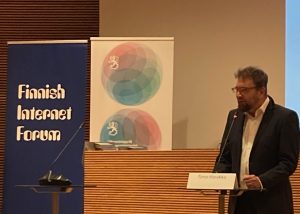
Finnish Internet Forum 2025
How to protect the infrastructure that our digital everyday life is based on, how to tackle digital harassment on the net? Finnish Internet Forum 2025, on 8 October, had to focus more on threats rather than opportunities. However, that was somewhat balanced by the third theme of the conference, WSIS+20 and its efforts to preserve for the future the best of two decades of the follow-up of the World Summit on Information Society.
Finnish Internet Forum, the Finnish national IGF, has since 2010 been organized by a wide array of stakeholders, among which the Ministry for Foreign Affairs and the Finnish Internet Association (ISOC Finland Chapter) have been the most consistently engaged, in partnership with the Committee of the Future of the Parliament, which again made it possible for the forum to meet in the auditorium of the Annex of the Parliament (“Little Parliament”)
The 2025 forum was opened by the Vice-Chair of the committee, Timo Harakka (MP-Social Democrats), who highlighted its role in enabling people to make the choices and decisions about the future, rather than just reacting to the development of technology. “Has the planet been harnessed to the needs of AI, or can we make the AI to serve the planet?”
In his opening remarks, Antti Vasara, the MFA special envoy on international technology policy, warned about the dangers of digital authoritarism, and called for sharper awareness of the spread of surveillance systems, censorship, and the use of technology for social control. “Finland is known for its strong digital competence and open society. We have an opportunity to lead the way not only in the development of technology, but also in its regulation in an ethical and people-centered way”, he said.
In his keynote speech, Kurt “Kurtis” Lindqvist, the President and CEO of ICANN since December 2024, returned to the times when he set up the first ISP in Åland, an autonomous province of Finland. In his speech, there was a clear line from those pioneering times to the present, when the Internet, despite its enormous expansion, still works well because “nobody owns, directs or controls” it. Internet is not about power, it is about cooperation, he said and warned about the efforts by “some countries” to centralize its governance in a way that may lead to fragmentation.
Resilience of digital infrastructure
Resilience of digital infrastructure, a hot topic in Finland after various incidents in recent months, was the theme of first panel. It was introduced by the moderator Julf Helsingius, Chair of the Board of Base N and member of the Board of ISOC Finland. He noted that to a certain extent, internet has resilience as built in, but it has its limits, and they t are being tested today.
Kurtis Lindqvist agreed that malicious attacks against the physical infrastructure are getting attention now, but policy decisions that fragment the internet may be equally dangerous. “We can have an internet the most resilient physical infrastructure, but if it then starts fragmenting, the harm can be worse than that from cutting sea cables, and it is easier to do,” he said and stressed the need to ensure the resilience of all layers of the internet.
Olli Peltonen, Commander (Ret.), Finnish Navy and senior consultant at COPOY, explained Finland’s dependence on sea cables in the Baltic for its international connectivity. Their location is public knowledge, and they are easy soft targets for malicious action, something that he saw behind recent incidents on the Gulf of Finland when ships had damaged cable by dragging their anchors on the seabed. “We are being tested”, he warned. In spite of apparent redundancy, we need to prepare for a worst case scenario. That means increasing the capacity for cable repairs, eg. by adding such capabilities to the Finnish icebreaker fleet, and rehearsing rerouting of communications.
Elina Ussa, the CEO of FICOM, started with simple fact: If networks fail, society stops. The priorities in Ukraine have been clear: keeping the country connected, no matter what. She encapsulated her recommendations in three points: 1) In a crisis, no operator or public authority can make it alone, mutual trust and coopation are a must, 2) Clear and predictable regulation; in a crisis, there is not time for lawyers to debate, what a paragraph means; 3) Training and practice: resilience can´t be legislated, it must be trained and tested. In Ukraine, national roaming became the lifeline, because operators had trained opening their networks to each other.
Maria Rautavirta, Head of Data Policy at the Ministry of Transport and Communications
agreed that the core of resiliency is not isolation, but switchability within s flexible structure, comparable to that of the internet itself. She noted that platforms had captured a large part of tasks that belonged to society, but now the European Union was working to get them back.
‘
Christiane Kirketerp de Viron, Deputy Director-General ,(Digital Society, Trust and Cybersecurity), of DG CONNECT, European Commission, participating remotely from Brussels, presented had the last word on this panel. She stated that resilience of European critical infrastructures has never been more relevant than now, when it is under continuing attacks in various ways. She also stressed the need of cooperation between public and private sector, and among all stakeholders, in implementing the robust policy structures now in place to defend the European critical infrastructures (NIST-2, Cyber resilience act etc.)
Tackling cyber harassment
The second panel was about tackling cyber harassment and making the Internet safer, moderated by Oona Kurppa, Chair of Generation Equality and introduced by Reetta Hänninen, Leading expert at. Sua varten somessa, an award-winning non-profit that operates on social media platforms to support youth aged eight to 21 years of age. She presented shocking survey results: 80% of young people had seen harassment on the internet, 40% had been its target. Digital harassment has become part and parcel of school bullying and other forms of abuse experienced by young people. Of 11 – 17 year olds, 31% have received grooming attemps by adults. Of targeted youth, 60 % don’t tell anybody about their experiences, and of those who do, they tell friends and not adults. Authorities become aware of only 10 %.
Ella Granström, anti-violence expert from Women’s line stated that digital harassment is also part of the experience for the women that seek help from her organization. Its exacerbates their fears and anxieties and leave them feeling hopelessly alone. For anybody trying to meet and help them, the key is to believe them and not to downplay the trauma they have experienced.
Minna Kröger, Corporate Responsibility Director of Elisa described the operator´s proactive approach to the problem by promoting the digital skills of Finnish children through its digital schools. Starting from the age of 7, children get to practice the basics of digital security and discuss their own safety online.
Atte Harjanne (MP – Green Party) noted that while the development of the Internet has lowered the threshold for digital harassment, the means that the state ruled by law have to cope with the situation have not been scaled up accordingly. He urged the platforms to take the problems seriously, and agreed with others that there should be a culture and means to ensure that young people are not left alone with their bad experiences.
Minna Kröger agreed with the last point and commented that according Elisa´s surveys, only 4 % nof the children who experience digital harassment feel that they can discuss it with an safe adult.
To the moderator´s question about the parlamentarians’ awareness of the problem and willingness to do something about it, Atte Harjanne replied that since the Internet presents a different face to each user, it may be difficult to the MP’s to understand children’s use experience. That´s why it is useful to hear about the problems from those who have to live with them, ie. childfren and young people, and not to try to dictate solutions over their heads.
All panelists agreed that tough children and young people, girls and women, and various vulnerable and visible groups are prone to digital harassment, it can also be a threat to society and democracy, because it is so easy, and because technical development – like AI – is making it worse.
A suggestion from the floor: as an analogy from urban traffic, “pedestrian crossings” should be provided by platforms as safe, harassment-free areas.
WSIS+20
The last item of the day was WSIS+20, especially the role of the Internet Governance Forum, which is going to be decided by the UN General Assenble by the end of the year. It was moderated by Mervi Kultamaa, councelor at MFA and member of the Board of the Finnish Internet Association (ISOC Finland chapter).
Miapetra Kumpula-Natri (MP – Social Democrats), who earlier as a Member of the European Parliament participated in the parliamentary track sessions of many IGF’s, related her experiences, including critical remarks and suggestions for how to improve the conference whose sheer size and huge selection of different topics make it problematic. Janne Hirvonen from MFA noted that the IGF is only the apex of a large system that has grown to include some 170 regional and national for a, including the Finnish one.
Closing remarks, with a succinct summary of the important points of the day´s proceedings, were presented by Kirsi Karlamaa, technology and strategy director of Traficom.
Finnish Internet Forum 2024
Finnish Internet Forum 2024 was held 3 June in the Auditorium of the Annex to the Parliament House in Helsinki at the invitation of the Committee for the Future of the Parliament, a cooperation partner of the FIF since its first meeting in 2010. The partnership with this committee – a parliamentary think tank with a mission to generate dialogue with the government on major future problems and opportunities – as well as with the Transport and Communications Committee – has enhanced the function of the FIF as an important annual event for interaction among all stakeholders, including members of Parliament.
In the focus of the 2024 FIF were artificial intelligence and resilience of the digitally-based everyday life in Finland. In addition, there was an update on the preparations for Global Digital Compact and for the 20-year review process of the implementation of the outcomes of the World Summit on Information Society (WSIS).
The Forum had about a hundred on-site participants, including members and staff of the Committee on the Future (which had listed FIF as a regular open committee meeting on its calendar) and about 200 online participants.
The overall moderator of the Forum was Janne Hirvonen, Second Secretary from the Department of International Trade of the Ministry for Foreign Affairs, coordinator of the FIF organizing group.
Opening the 2024 FIF, the Chair of the Committee for the Future, Anna-Kaisa Pekonen, pointed out that its themes were also high on her committee’s agenda. In her opening remarks, Techology and Strategy Director of the regulatory agency Traficom Kirsi Karlamaa touched the resilience theme of the Forum, noted the growing number of DDoS attacks and other security problems and called for more cooperation among all actors in countering them. AI will create both opportunities and threats, and Finland has to be active, innovative and open in benefiting from the former and tackling the latter.
1st Panel: EU artificial intelligence regulation – already out of date?
Most panelists, but not all, agreed with the title. Member of the Committee for the Future Aura Salla pointed to the Metaversum development that has been going on for years in Silicon Valley and called for more realistic regulation. “There is already a huge amount of regulation, overlapping every which way”, she said.
Development Manager of Save the Children Anna-Maija Ohlsson noted the many harmful effects on children of the digital environment that AI may make even worse. She favored more effective control of content, early recognition of risks and inclusion of children themselves in planning how to counter them.
According to Executive Director Tapani Tarvainen of Electronic Frontier Finland, the EU AI Act relates to yesterday’s technologies, while technical development is rushing forward.
Professor Pauli Myllymäki from the University of Helsinki brought up the question of different possible interpretations of the AI Act.
In the ensuing discussion, various problems of AI governance were brought up, including lwhether government bureaucracies are sufficiently competent for dealing with it. Regulation was seen to favor large enterprises, as they have most resources to influence interpretations and decisions.
Increasing awareness of AI-related challenges and opportunities among citizens was seen as important, with mainstream media in a key educative role in this regard. Many families feel that AI is not for them or their children, which can increase inequality. AI sets new demands on teachers charged to instill critical thinking and digital literacy in their pupils.
In his commentary, Senior Adviser Joonas Mikkilä from Technology Industries of Finland welcomed the EU AI Act’s risk classification, which enterprises can use to assess their own activities, but the enormous size and complexity of the field as a whole remains a challenge.
Participating remotely, MEP Miapetra Kumpula-Natri noted that AI Act was adopted by the European Parliament with a clear majority. She mentioned the new EU AI Office set up by the European Commission to support the development and use of trustworthy AI, while protecting against AI risks.
The first panel was moderated by Tommi Karttaavi, Chief Digital Officer of the Wellbeing services county of Eastern Uusimaa and honorary President of the Finland chapter of Internet Society.
2nd Panel: Cyber Security and New Technologies
Setting the scene for the discussion of the resilience of the digital resilience of everyday life, Cybersecurity Lead Petri Puhakainen from VTT Technical Research Centre of Finland noted that G 6 is already on the threshold of becoming reality. All manner of home appliances are eagerly waiting to connect, and networks themselves are expanding so that even the sky will no more be the limit.
Noora Hammar, Founder of Women4Cyber Finland stressed the need to assure the necessary competences and widest possible cooperation between various actors.
According to Research Director Mikko Hyppönen from WithSecure, the problem is that people are too trustful and increasingly falling for a growing array of tricks and hoaxes. Algorithms grow more sophisticated, capacities expand, authoritarian states are making colossal investments in quantum technology to break encryption, and dangerous situations are becoming more common. But on the other hand, defense capacities are growing too. Educational institutions play a key role. Future generations are not automatically “digital natives”. Regulation is not a cure-all, but at least provides a necessary framework and guidance to a right direction.
The second panel was moderated by Stefan Lee, Deputy Cyber Security Director at the Ministry of Transport and Communications.
Update on Global Digital Compact and WSIS-20
After two panels and a light lunch (sponsored by the Internet Society Foundation), the last program item was an update of the preparations of the Global Digital Compact and of the 20-year review of WSIS follow-up remotely by David Souter, Managing Director of ICT Associates, who as consultant to the United Nations had been heavily involved in the previous (ten-year) WSIS review. In his opinion, as to its importance, GDC will be comparable to the WSIS final acts. If the latter would be negotiated today, they would focus on the goals of the GDC. As it happened, the zero draft of the GDC had been published the day before. In Souter’s view, it was better and more substantive than many, including himself, had expected.
Commentary from the Finnish government point of view was provided by Aki Enkenberg, Senior Adviser on development cooperation policy in the Finnish Ministry for Foreign Affairs. He reminded that digital governance discussions are going on, and regulatory build-up is taking place also on regional level, including in the European Union, and that the optimal role of the United Nations should be subject of careful consideration in the drafting process of GDC.
In his concluding words, Timo Harakka, Vice Chair of the Committee for the Future stressed the need to maintain the multistakeholder approach in meeting digital challenges of the future, among which AI now looms large, and could even develop into one of the most important political questions of our time.
Finnish Internet Forum 2023
The 2023 meeting of Finnish Internet Forum was held on 19 June at Tampere University, the first time outside the capital Helsinki since its founding 2010. As another novelty, it was organized in connection with the year’s EuroDIG, also hosted by the university, as one of its preparatory (“0-day”) EuroDIG events. To my knowledge, this was the first example of integrating a national and regional NRI’s in Europe.
There were synergy benefits for both NRI’s, as the same actors were in charge of organizing the Finnish forum and helping the university in hosting the EuroDIG. The two NRI’s shared the services provided by the university communications office, congress bureau and restaurant, as well by volunteer faculty members and students. They also shared the elaborate technical facilities set up by EuroDIG. As English was also the language of the Finnish Internet Forum, there was an opportunity for cross-participation between the two NRI’s. On the other hand, on the 0-day schedule, Finnish Internet Forum was just one if four parallel pre-events, so that it faced stiff competition for the interest of onsite participants.
Venue was provided free of charge by Tampere University, the most multidisciplinary university in Finland with a strong profile both in technology and social sciences. Its partners were Ministry for Foreign Affairs, Internet Society’s Finland Chapter, Electronic Foundation Finland, Finnish Information Processing Association (TIVIA) and Finnish Broadcasting Company (YLE). Financial support was given by Internet Society Foundation and TIVIA.
Finland’s political calendar 2023 presented a challenge to both NRI’s. General elections in April impacted their preparations on various ways, from the reluctance of government actors to become financially involved, to last-minute uncertainties of VIP participation, as the formation of new government was going on. Nevertheless, Finnish Internet Forum managed to get the Minister of Transport and Communications of the outgoing government, Timo Harakka, on his last day in office, to travel to Tampere to deliver opening remarks and to give a “Meet the Author” interview about his new book “Data Capitalism in a world of crises”.
The main topics of the Finnish Internet Forum were (1) ethical issues related to artificial intelligence (AI) and (2) development of Fediversum-type social media as alternatives to those provided by tech giants, especially public actors who have grown uneasy after de facto outsourcing a large part of their communications, especially to Twitter (now X). Both issues were also dealt with at EuroDIG sessions.
After the Finnish Internet Forum, the 0-day program continued with the NRI Assembly and the EuroDIG opening session.
Finnish Internet Forum 2022
Due to COVID-19 restrictions, in 2022 the Finnish Internet Forum (FIF) was organized in two parts: a one-issue event in the spring, and a full-scale event in the autumn. Both events were streamed and are available for viewing at Internet Society Livestream.
A panel discussion on ‘Internet and War’ was organized on Monday 23 May at the Think Corner of the University of Helsinki. An expert panel discussed how the ongoing war has affected the internet, as well as how the internet has been utilized and what effects this has on society. The panelists were Mikko Hyppönen (F-Secure), Catharina Candolin (OP financial group, expert on cyber security) and Peter Sund (CEO of Finnish Information Security Cluster FISC ry). The event was moderated by Johan ’Julf’ Helsingius, the Chair of the Finnish Chapter of ISOC.
Link to the recording:
The second and main part of the 2022 FIF was held 29 September in the Auditorium of the Annex of the House of the Parliament, the prestigious venue that FIF has been privileged to use for most of its sessions since 2010, due to excellent cooperation with the Committee on Transport and Communications and the Committee on the Future of the Parliament.
The forum was opened by the Chair of the Committee on Transport and Communications, Suna Kymäläinen. She noted that internet-related issues have a central place on the agenda of the committee, and that they need to be subject of a broad multistakeholder discussion as well, something that FIF, for its part, facilitates.
Adressing the forum, Minister of Transport and Communications Timo Harakka stressed Finland’s policy objectives: safe, open, global Internet (“We want an internet, not a splinternet”) which enables transparency, control of one’s own data and equal participation opportunities for all stakeholders. All measures, national and international, should aim to developing human-centric solutions, and prevent the use of the Internet in restricting human rights and fundamental freedoms.
In a video keynote, MEP Mia-Petra Kumpula–Natri presented the view from her vantage point in Brussels on the multipronged Internet-related legislation now being
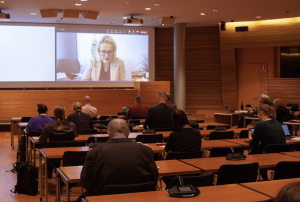
prepared. However, she cautioned, not everything can be achieved by legislation. There is room and need for multistakeholder action in all areas.The first panel tackled the question, whether the giants of platform economy are the best thing that happened to freedom of expression since Gutenberg, or are they a threat worse than imagined by Orwell? And further, do the attempts by governments to control discussion on the Internet threaten the freedom of expression, or do they save it from all evil?
The Chair of the Finnish Chapter of Reporters Without Borders Yrsa Gruene-Luoma, Director for Public Affairs of Google Finland Heidi Jern, Ambassador (Digitalization/Technology Affairs) Stefan Lindström and Dr. Matti Nelimarkka from the Centre for Social Data Science, University of Helsinki discussed the questions, all opting for answers somewhere in between the extremes. The panel was moderated by the Vice Chair of Electronic Frontier of Finland Tapani Tarvainen.
The second panel looked into new European Internet-related legislation from the point of Finnish individuals and companies, especially the benefits they may bring to SME’s. A study on the latter made at the Finnish Innovation Fund (SITRA) was presented by its Specialist in Fair Data Economy Meeri Toivanen. Senior Security Specialist at Ministry of Transport and Communications Marième Korhonen discussed the Data Market Act, Senior Specialist at the Ministry of Economic Affairs and Employment Iiro Ihanamäki the Data Service Act, and Senior Ministerial Adviser at Ministry of Transport and Communications Kreetta Simola the second Network and Information Security Directive (NIS-2).
Changing the language of proceedings from Finnish to English, the third panel traced the road toward Global Digital Compact. The role of Internet Governance fora at all levels – global, regional, national –in its preparations was discussed by NRI Coordinator Anja Gengo and Programme and Technology Manager Chengetai Mansango at UN IGF Secretariat and Councelor Juuso Moisander at the Finnish Permanent Mission, who all joined the discussion from Geneva, as well as IGF Leadership Panel Member Lisa Fuhr, who managed to connect while waiting for her plane at an airport, and EuroDIG Secretary-General Sandra Hoferichter, who also made a presentation on the 2023 EuroDIG (to be held 6-8 June in Tampere, Finland). This segment was moderated by ISOC Finland Vice Chair Yrjö Länsipuro.
Link to the recording:


